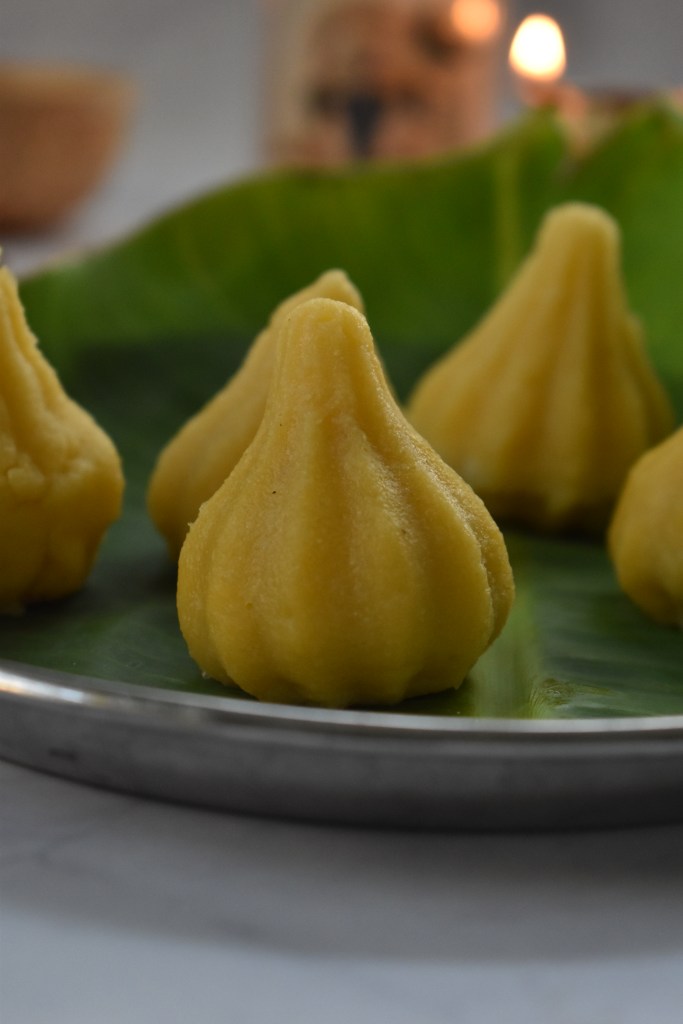
The joyous spirit of Ganesh mahotsav is already in the air and it is time to rejoice yet again as the festive season has already begun with the arrival of our favourite God Lord Ganesh which is to be followed by a series of festivities for the year. Festive mood sweeps out all the negativities to give people some respite from the physical and psychological fatigue. For me this autumn time is the best time of the year where I get loads of positivity which I store and carry over for the rest of the year. Ganpati worship is an extravaganza in Maharashtra and is also celebrated in a big way in the entire Southern India, Gujarat and Orissa. However, nowadays the celebration has not remained restricted to these states only, rather its popularity has spread nationwide and so are the foods special for this occasion. Perhaps this feeling of unified joy across the country has given me the impetus to try out this maharashtrian delicacy this time with a touch of Bengal. Lord Ganesha is a symbolic of wisdom, wealth & prosperity and brings in with him abundant joy, happiness, peace & good luck removing all the obstacles & darkness from your path illuminating every corner of your life.
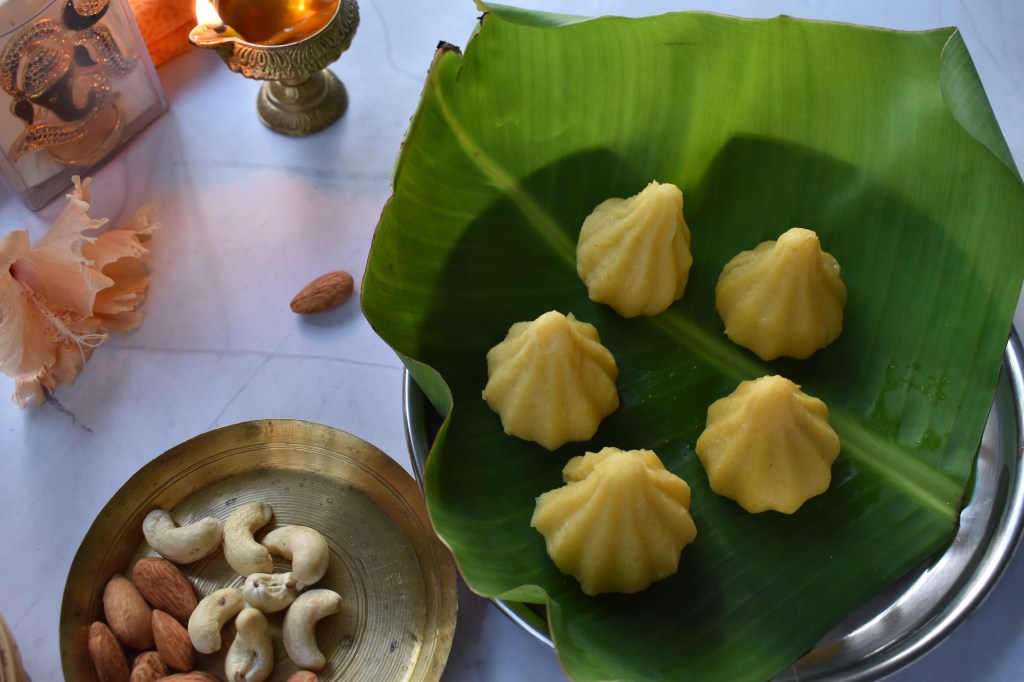
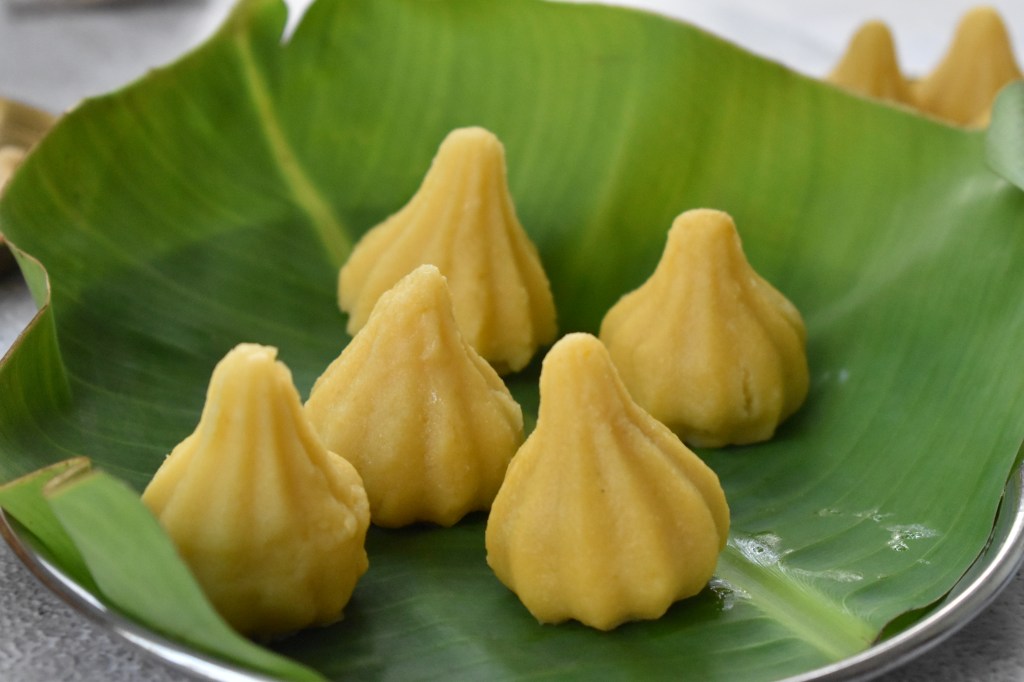
Modak is known to be one of the most favourite offerings being presented to ganesha during ganesh puja and it is thought to have originated from an ancient sweet Modaka whose history dates back to around 200 BCE and also have mentions of it in Ayurveda, Ramayan & Mahabharat. Modakas were also dumpling sweetmeats with a sweet stuffing inside. The medival Manasollasa and Sangam literature of south India also described modaka as a dumpling sweet prepared from rice flour with sweet stuffing which is flavoured with aromatic spices like cardamom & camphor and steamed. According to hindu literature the word modaka is said to have derived from the words “Moda” and “Pramoda” which means joy, happiness, pleasure or delight. The term ‘modak’ which means “small part of bliss” is thus synonymous with all the pleasures of life i.e. good luck, wealth & happiness packed together in a small parcel that ganpati bappa bestows on his devotees in the form of Modak as Prasad. For me Modak is simply a divine connotation.
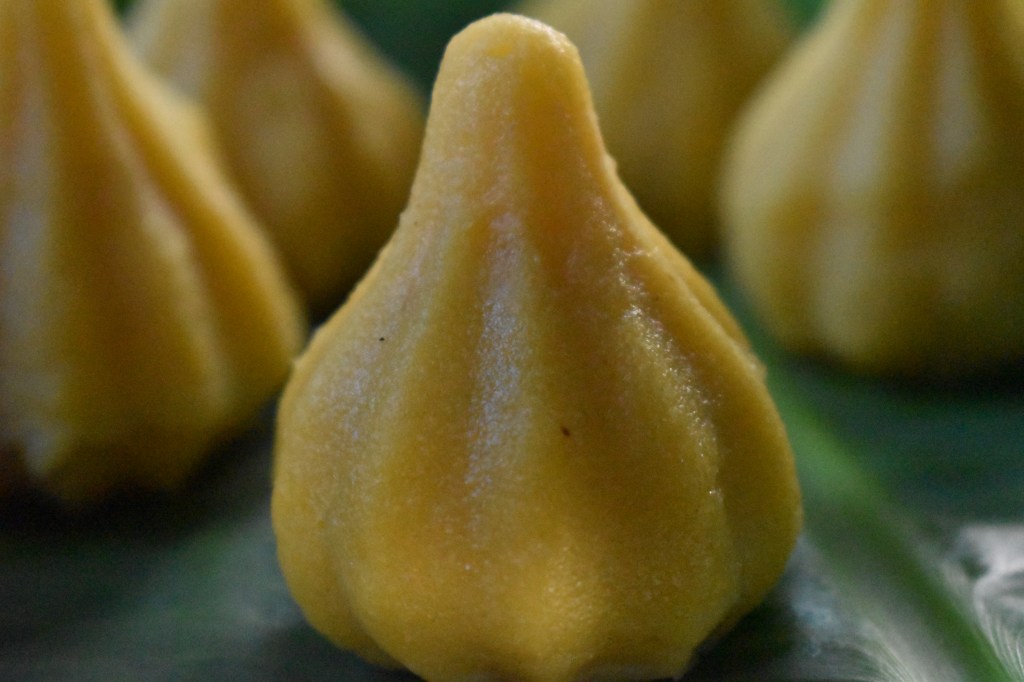
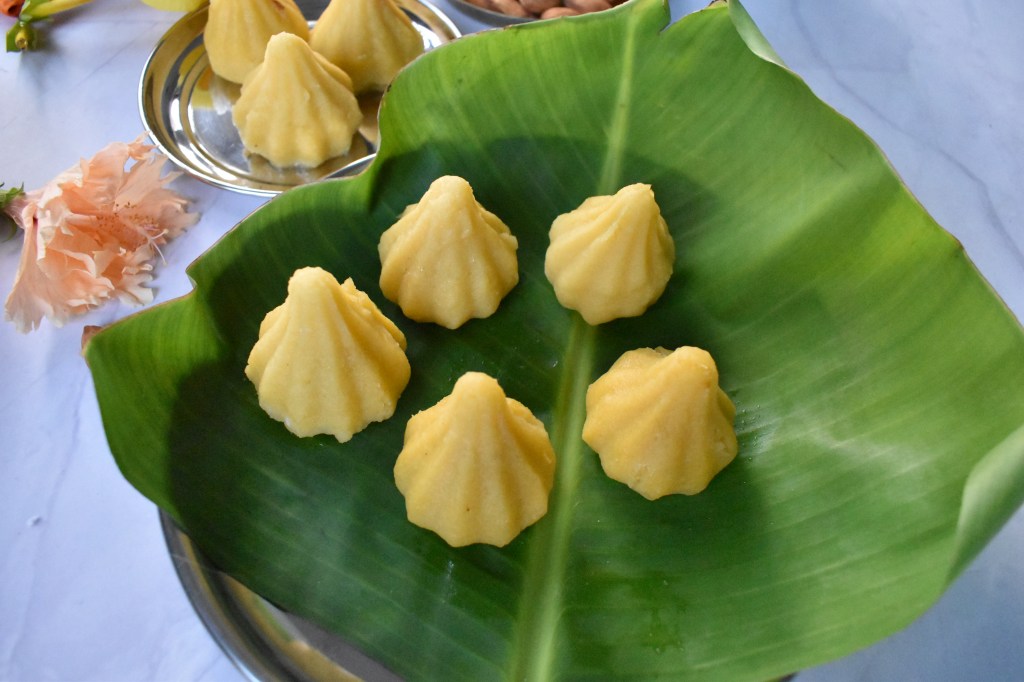
I tried this divine sweet with my own version using Taal / Taad fruit or Palmyra palm as the main ingredient and it really overwhelmed me with its melt in mouth taste. Fully ripe Taal fruit is amply available during the months of August & September and so it is a perfect ingredient to please our deity with something different that can be in the que with other varieties of modak being prepared apart from the traditional varieties
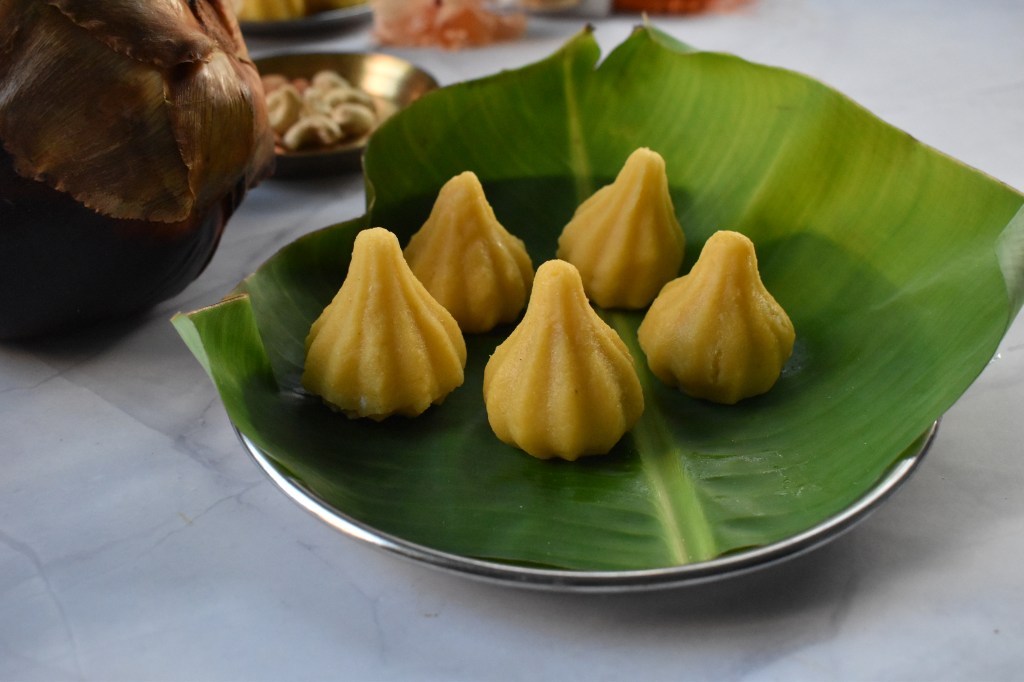
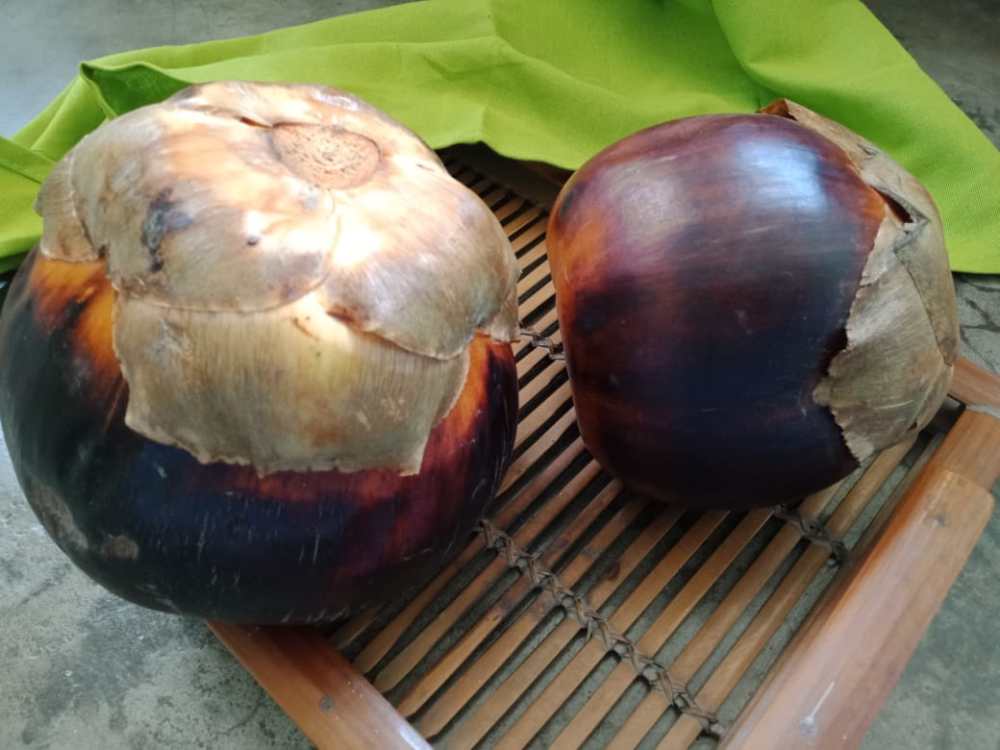
Palmyra palm (Borassus flabellifer) is a kind of palm tree. The fruit of palm i.e. Palmyra fruit or Taal/Taad fruit is medium in size with a diameter ranging from 10cm to 18 cm which is blackish brown in colour when ripe. It is available in many parts of India mostly being in the tropical regions of eastern and southern India. Each fruit usually contain 1 to 3 seeds and each seed encloses a sweet jelly seed socket inside the very hard covering. These sweet jelly seed sockets are pale white translucent in colour and are named as ice apple i.e. taal shaansh in Bengali which is the inspiration behind the famous taal shaansher shondesh & jolbhora shondesh in Bengal. Other than the sweet seed inside, we Bengalis also extract the yellow, dense, juicy pulp from the fibrous mesocarp to prepare many sweet delicacies such as taaler bora or kheer being the most popular ones. This dense juicy pulp is mildly sweet in taste with a very sweet aroma. The sweet taste is accompanied with a little astringent flavour due to the presence of a bitter compound called flabelliferrins in it. The extraction of pulp is a bit time consuming affair and truly needs some patience. I have given a detailed step by step procedure below for the extraction of the same. However packaged pulp is also available nowadays in some stores or online that can also be used instead to make your task easier. Here is the recipe below for my Taal Modak, have a look:
RECIPE :
[Recipe inspired from Dassana’s Veg recipes of India ](https://www.vegrecipesofindia.com/modak-recipe-ukadiche-modak-recipe/)
Ingredients :
A) For the dough covering :
- Rice Flour – 1 cup.
- Water – 1.5 cup
- Refined oil (or any neutral oil) – ¼ tsp.
- Salt – ¼ tsp.
- Taal/Taad pulp – 5-6 tsp.
- Coconut (freshly grated) – 2 tsp.
B) For stuffing or filling :
- Khoya – 2/3 cup.
- Coconut (freshly grated) – ½ cup.
- Taal pulp – 4 tsp or 2 tbs (Note : The amount of taal pulp used should be reduced depending on the astringent taste of Taal. If the taal has lesser astringent taste, you may use it generously otherwise it may create an unpleasant taste in your recipe.)
- Almonds and Cashews (finely chopped) – a handful.
- Sugar – 7 to 8 tsp or as per taste.
Preparation :
A) Extraction of taal/taad pulp.
1. Take a fully ripe taal fruit (Note: While choosing a taal fruit, prefer taal with darker colour as darker the colour is, better the taste is).
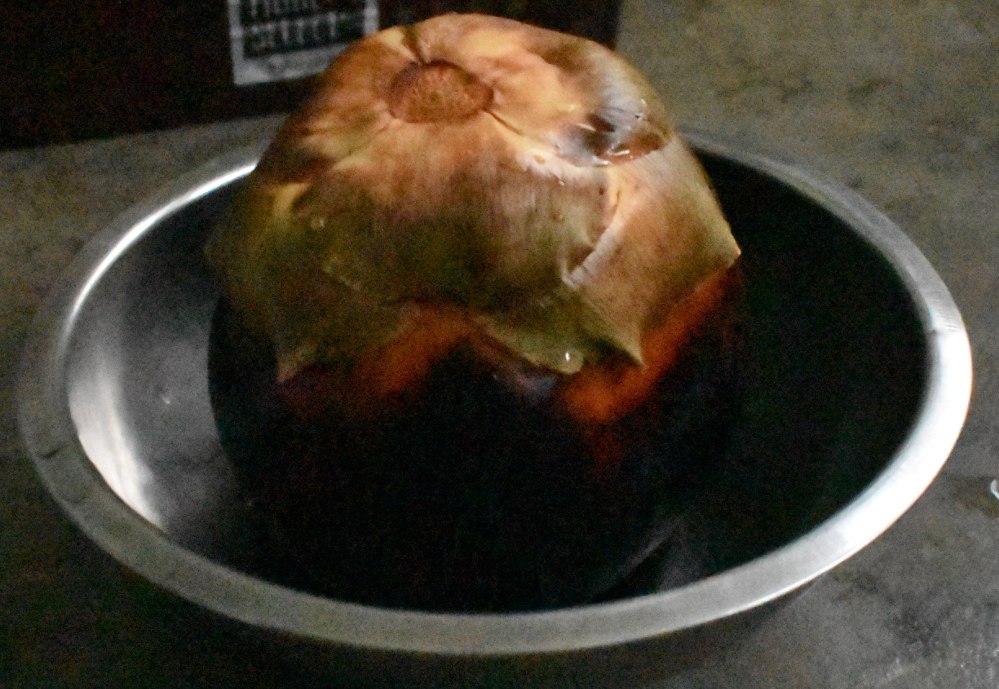
2. Wash it thoroughly.
3. Remove the cap at the top as shown in the picture below.
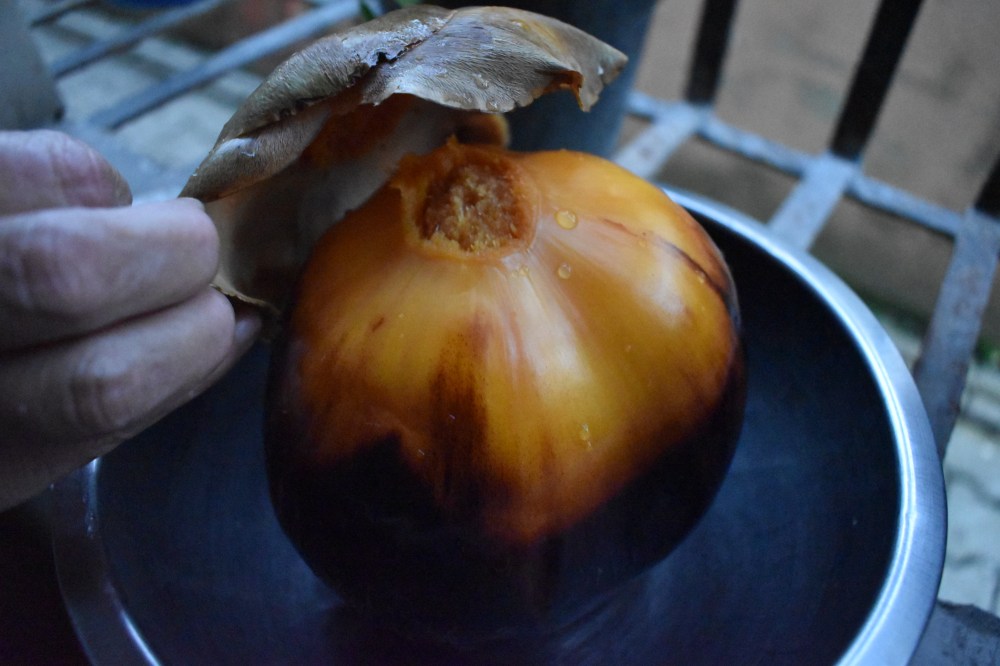
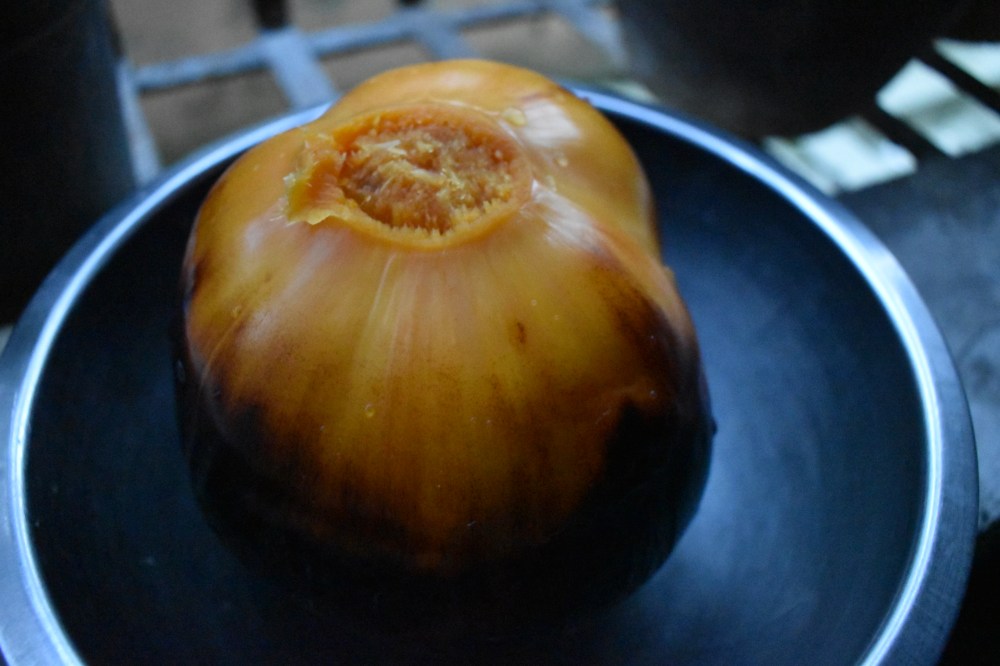
4. Now start peeling the outer skin of the fruit from top to expose the light orange coloured fibrous mesocarp of the fruit.
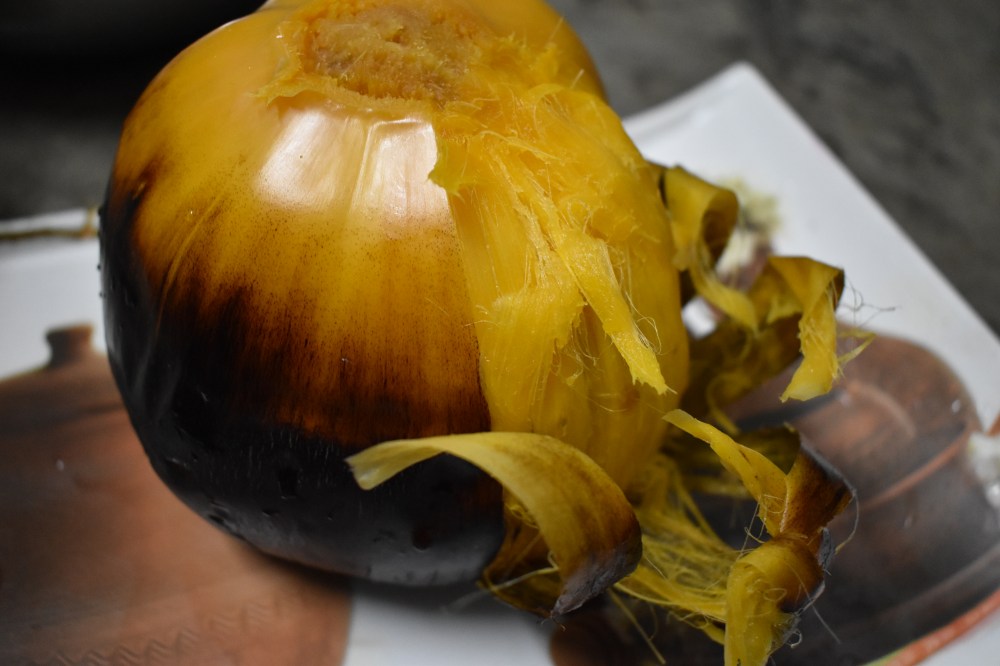
5. Continue peeling till the outer skin is completely removed as shown below.
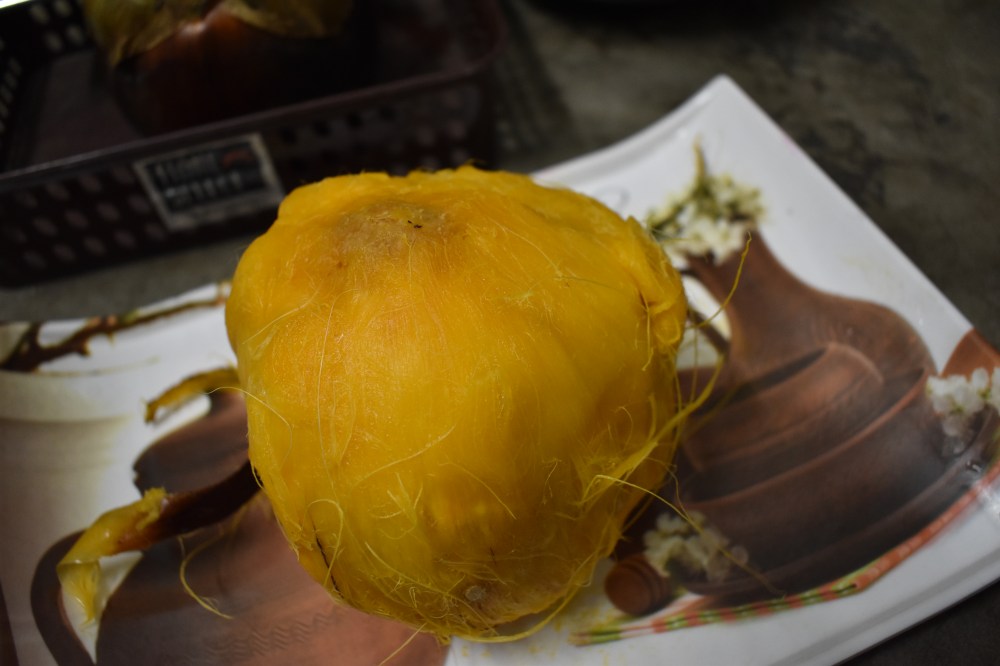
6. Separate the seed from one another. Each fruit contain 1 to 3 seeds in it.
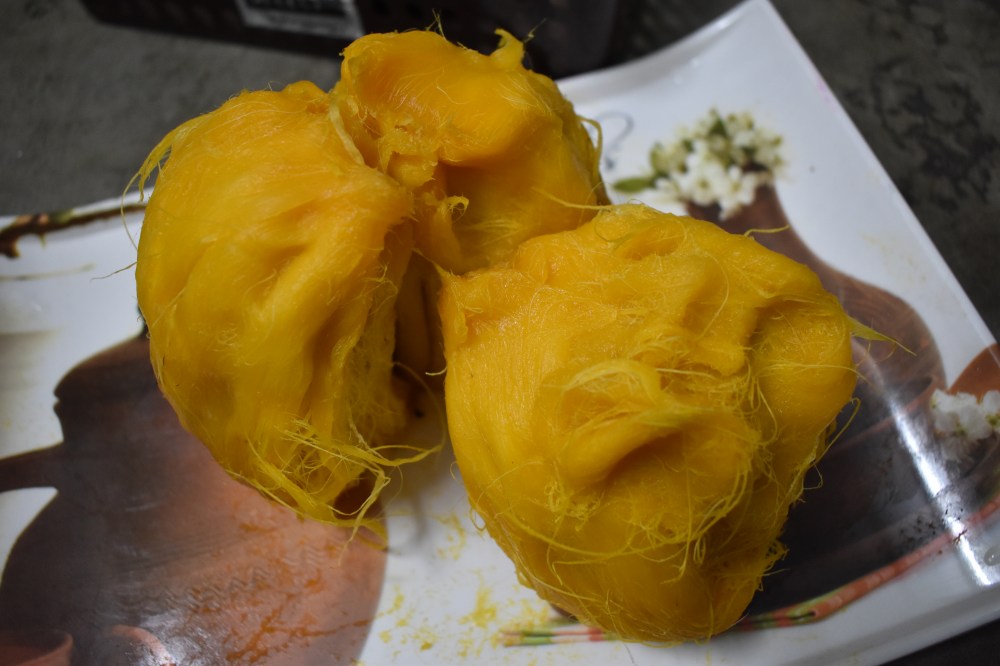
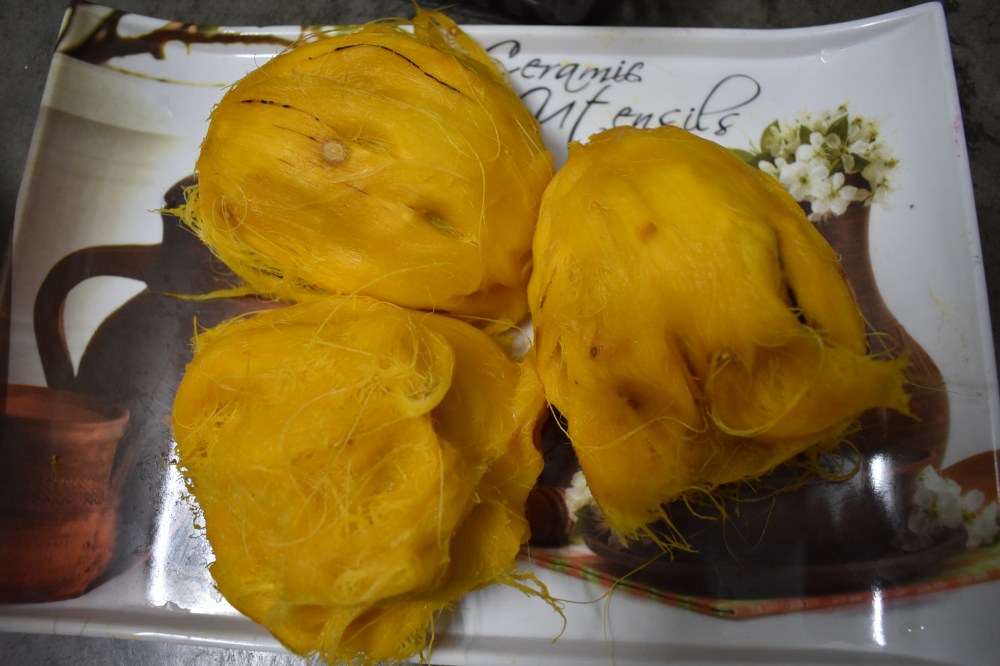
7. Take the seed in a large container and add some water to it to make it moist.
8. Take a wire colander or a large grater over a large bowl to rub the seeds on it for extracting the orange pulp contained in the fibrous mesocarp. Below is the picture for your reference. ( Note: This step is little time taking, so make sure you have enough time).
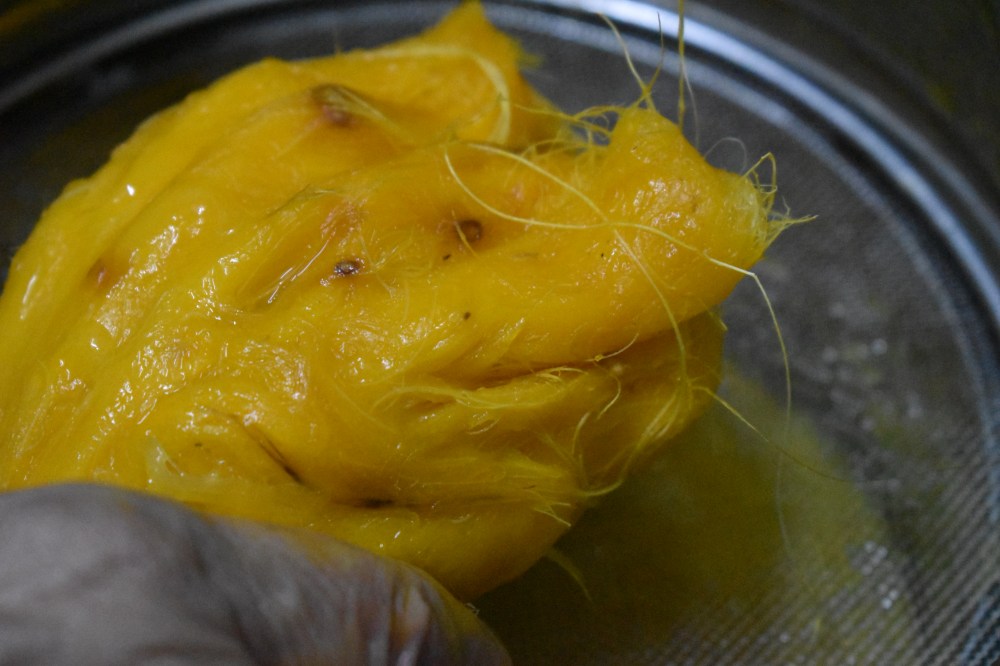
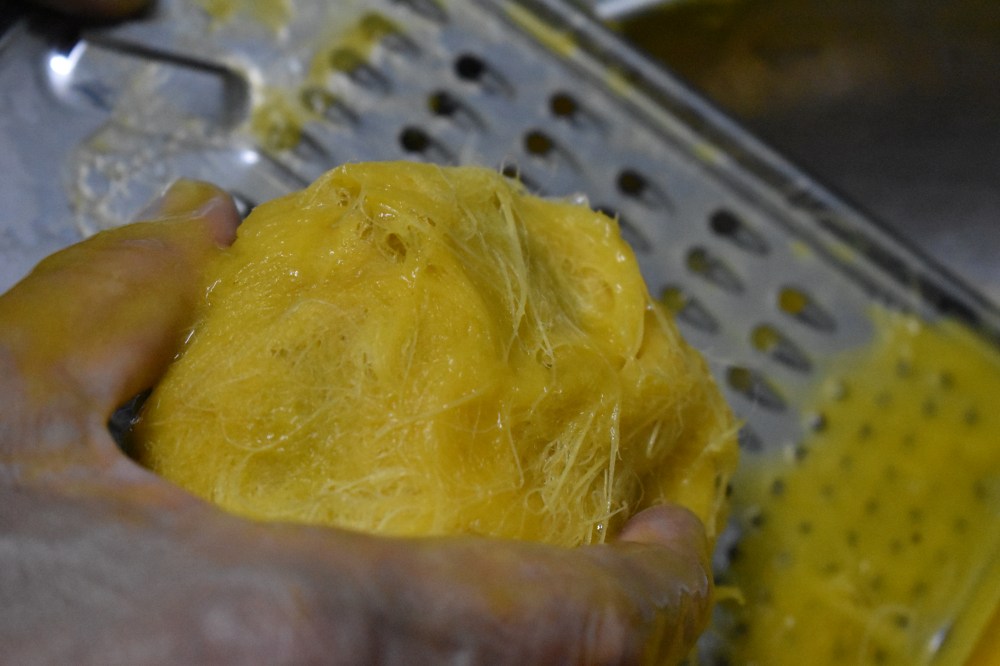
9. Take one seed at a time and rub by repeatedly immersing it in water if you feel it dry.
10. Continue doing until all the pulp is extracted from the fibrous seeds.
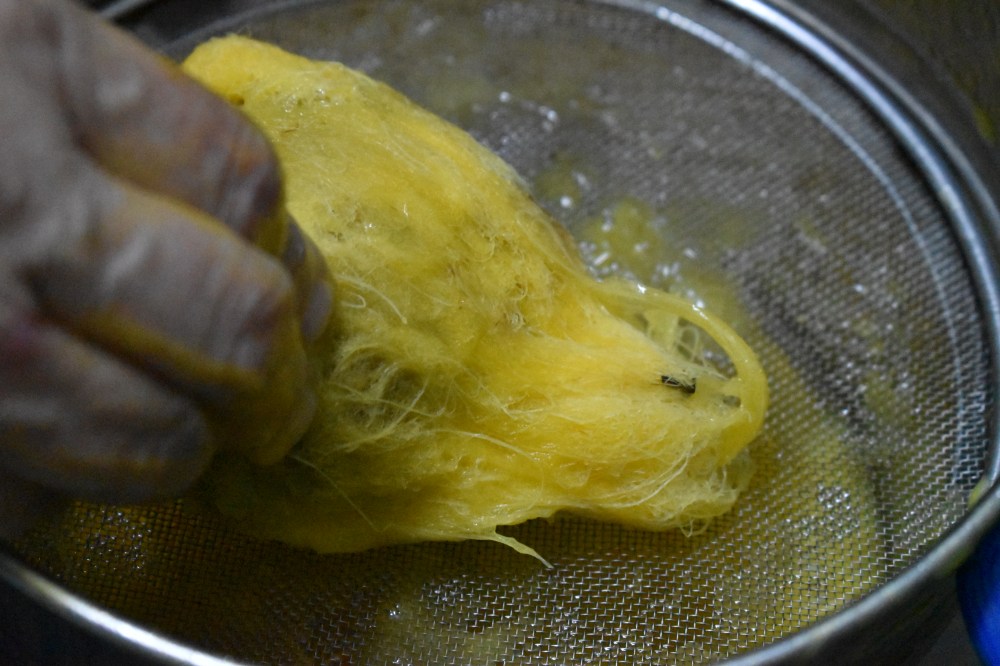
11. Strain the pulpy juice extracted to remove bits and parts of the fiber if any.
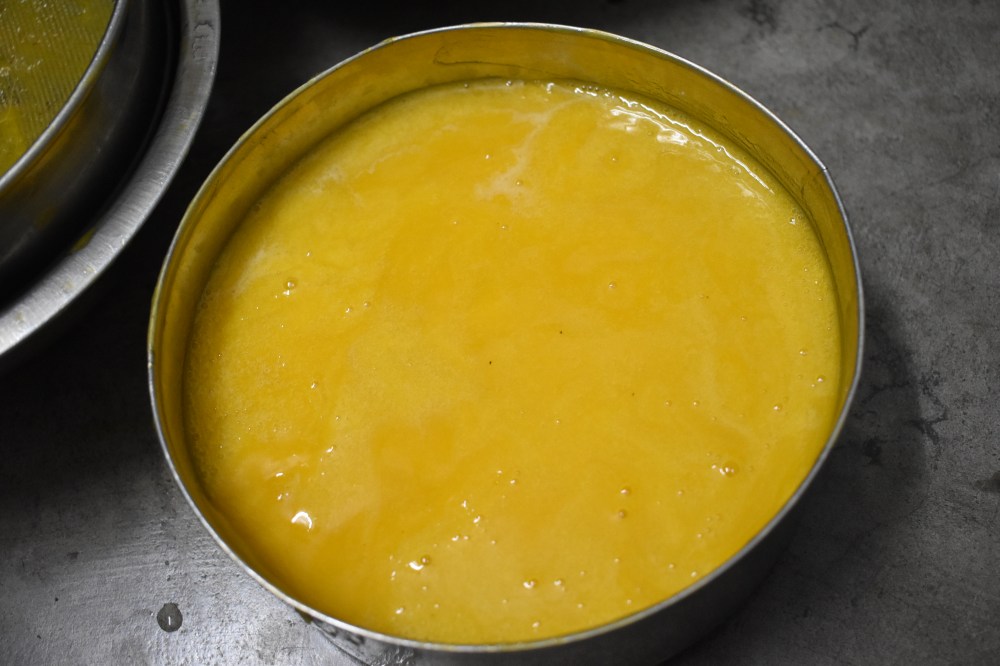
12. Collect the entire strained pulp in a muslin cloth and tie a knot to form a bun in the same way as we do for making cottage cheese. Below is a picture showing the same.
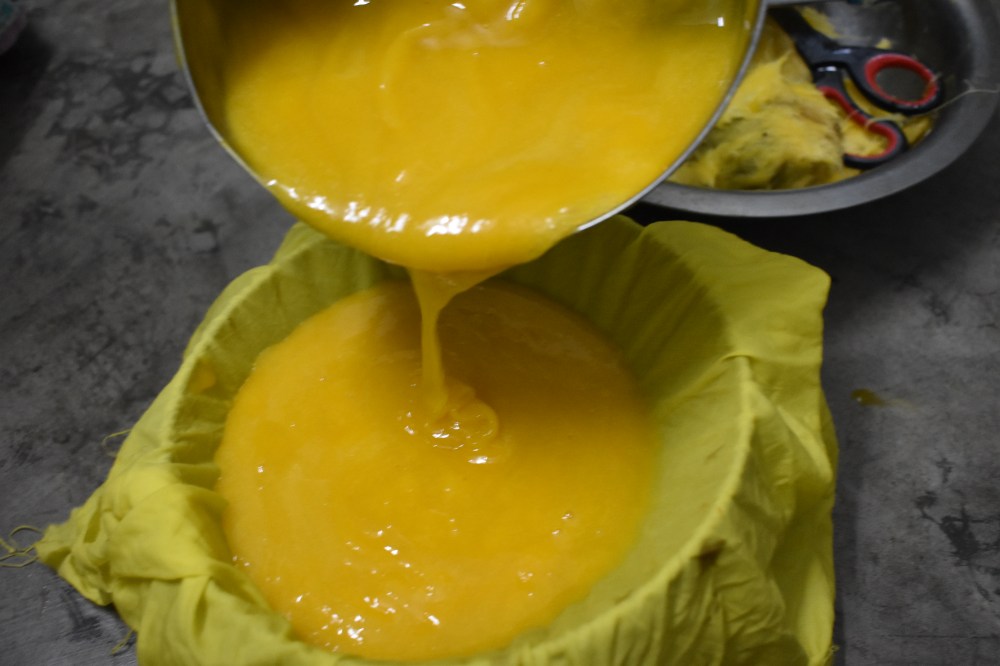
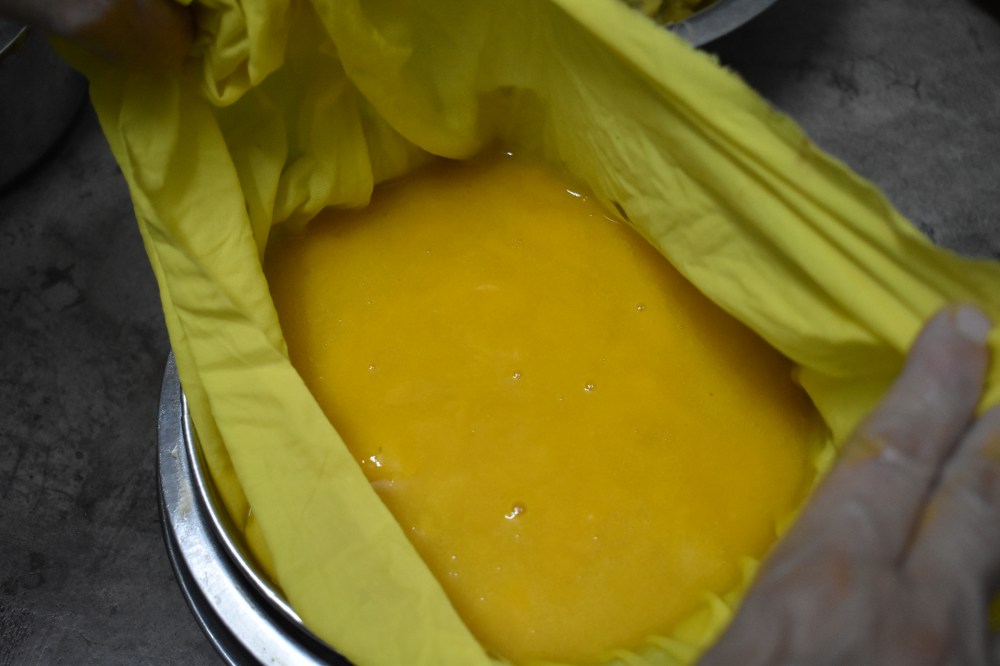
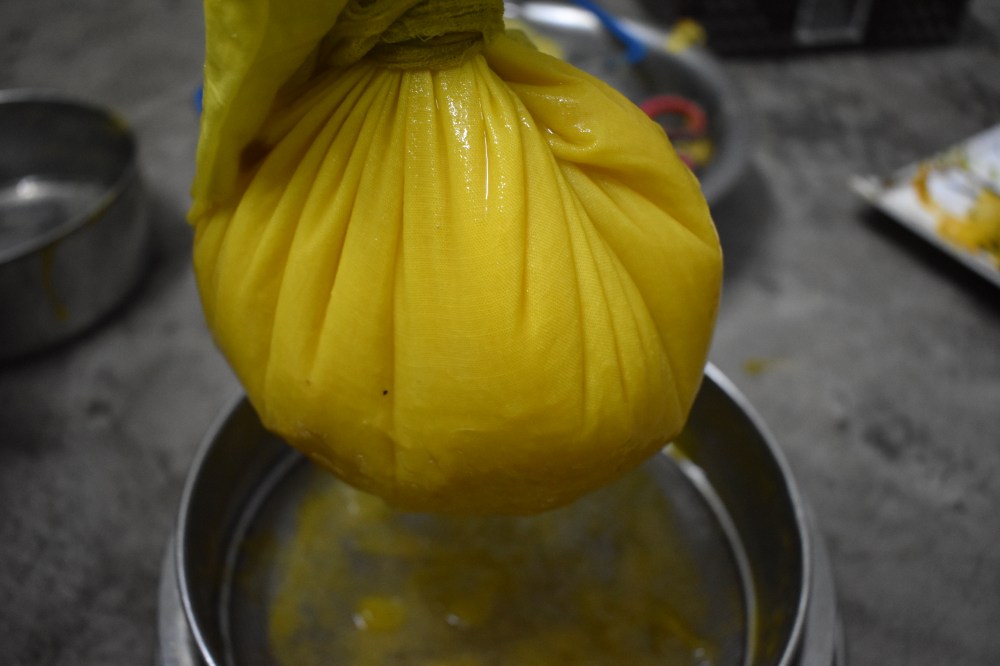
13. Apply little amount of lime (chuna) at the bottom of the bun outside the cloth as the lime will help in removing the astringent taste of taal fruit.
14. Hang this muslin cloth parcel for 5 to 6 hours or overnight to remove its astringency completely.
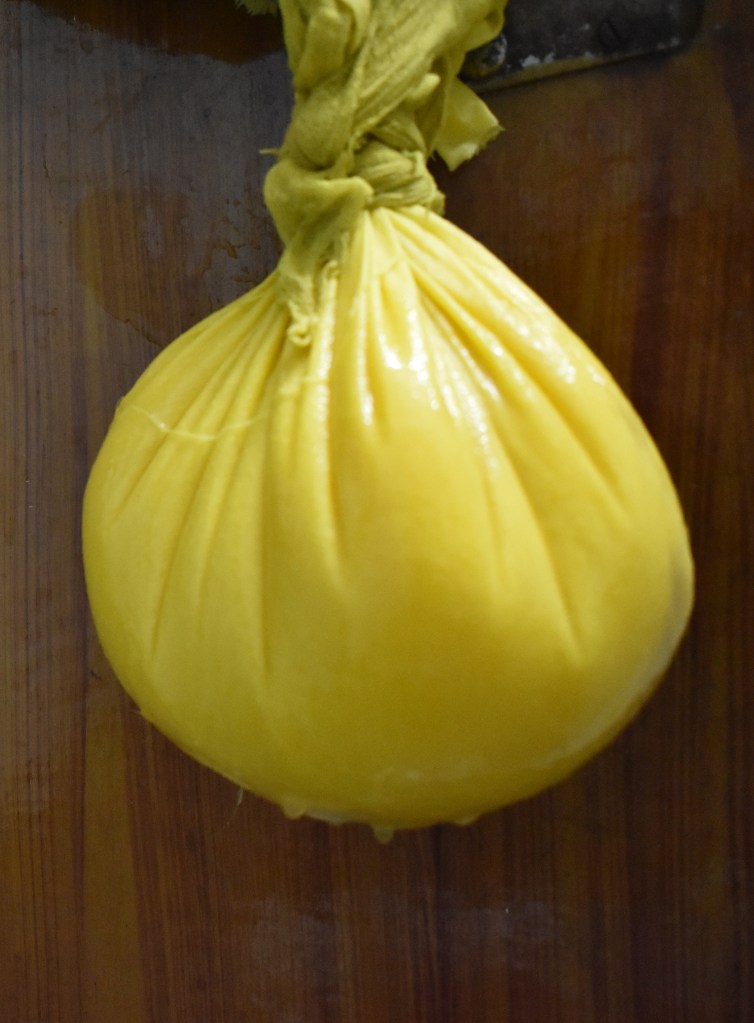
15. Take out the pulp from cloth & collect it in a air tight container & store in the refrigerator. The pulp is now ready for use in any dessert you want and can be stored for few days.
B) For preparation of stuffing :
- Melt sugar with some water in a pan over a low flame.
- Add Khoya, stir and mix well till the khoya melts completely.
- Add grated coconut, mix and add the taal pulp. Stir the mixture well so that everything blends well together.
- Add the chopped cashews and almonds and continue stirring till the mixture turns more thick and gets accumulated together with a dense but not dry texture. (Note : Do not overcook the mixture as the khoya in it may turn hard. Your stuffing should be moist and soft but not loose and it should not be dry or hard, for better taste).
- Turn off the flame, bring down from the flame and let it cool.
- Your stuffing is ready for use.
C) Preparation of modak dough :
- In a pan add water, oil and salt together, mix and keep for boiling over medium flame.
- When the mixture is hot enough, reduce the flame to low and add the taal fruit pulp, mix them thoroughly so that the pulp gets completely dissolved in the water mixture without leaving any particles giving a homogenized orange coloured water mixture.
- Bring the mixture to boil.
- Add the rice flour gradually while the flame is still low. Stir & quickly mix the rice flour with the water pulp mixture. Continue stirring till the rice flour is completely mixed with the water.
- Switch off the flame and bring it down. Cover with a lid and keep for 4 to 5 minutes.
- Uncover and take the dough on a plate.
- Wet your palms with water and start kneading the dough to make it smooth so that no lumps are left.
- Add some grated coconut to it and knead it very well. (Note : If you feel the dough is hard, dense or dry while kneading add 1 or 2 tsp of warm water and knead again).
- Keep the kneaded dough covered with a damp muslin cloth or towel so that the moisture is retained in the dough.
- Now make small smooth balls from the dough (Note : The balls should not have any cracks in it).
- The balls should be kept covered with the damp cloth.
D) Making the modak using mould (Note: I have used modak moulds to make my modak. However, you can simply use your hands to shape your modak)
- Grease the modak mould with little oil or ghee and lock or close the mould.
- Take a dough ball and insert it into the mould from the open end at the base or bottom.
- Press the dough ball to make a dent or space at the center and press the dough at the sides along the wall of the mould to shape it.
- Take small amount of the stuffing and put it inside the space.
- Take little more dough and cover the stuffing with it. Press to seal the modak properly and smoothen it with your fingertips.
- Unlock the mould and take out your modak gently from the mould.
- Keep on a thali or tray and cover with a cloth or napkin to prevent drying out.
- Shape your remaining modaks in the same way.
E) Steaming of modaks:
- Grease a pan for steaming the modaks with little oil.
- Put the shaped modaks in it by keeping some distance between each modaks and cover it (Note : You may steam them in batches if more in numbers).
- Take 2 to 2.5 cups of water in a pressure cooker or steaming pan and put a wire rack or stand in it.
- Bring the water to boil at a high flame.
- When the water starts boiling bring down the flame to low & put the covered pan with modak over the wire rack or stand and cover the steamer with lid.
- Cook them for 12 to 15 minutes.
- After 12 minutes, you may uncover and check the modaks using your fingers. If they feel sticky, steam for few more minutes.
- Switch off the flame, remove the lid and carefully take out the pan with modak as it is still hot.
- Uncover & let it cool for few minutes and your perfect soft yummy modaks are ready to be served.
Note : Points to remember.
- Do not add more oil or ghee than what is mentioned in the recipe as it will lead to tearing of the dough while shaping.
- The dough should not be dry as it will lead to cracks in the modak.
- The dough should not be too thick or too thin for bringing the perfect taste of the modak.
Courtesy :
- https://en.wikipedia.org/wiki/Modak#:~:text=The%20word%20modak%20means%20%22small,shell%20versions%20are%20also%20used.
- https://en.wikipedia.org/wiki/Borassus_flabellifer
- http://researchjournal.co.in/online/RKE/RKE%2012(2)/12_35-40.pdf
- http://theindianvegan.blogspot.com/2013/01/all-about-nungu-ice-apple-or-taal.html
- https://www.vegrecipesofindia.com/modak-recipe-ukadiche-modak-recipe/
Discover more from FOODIESTREASURE
Subscribe to get the latest posts sent to your email.

 FOODIESTREASURE